Why your Jira time estimates are always wrong (and what to do)
Jira estimates are biased low, not randomly off. Why software estimates run short, why Jira hides the miss, and how logging real time calibrates them.
On this page
Your Jira estimates aren’t wrong because you’re bad at estimating. They’re wrong because every estimate is a prediction made at the moment you know the least about the ticket, and software work has a systematic bias: the things you forget to account for (review rounds, interruptions, the scope that quietly grows) all push the same direction, longer. The errors don’t cancel out. They stack. So the actuals come in over the estimate, sprint after sprint, by a margin that turns out to be surprisingly stable.
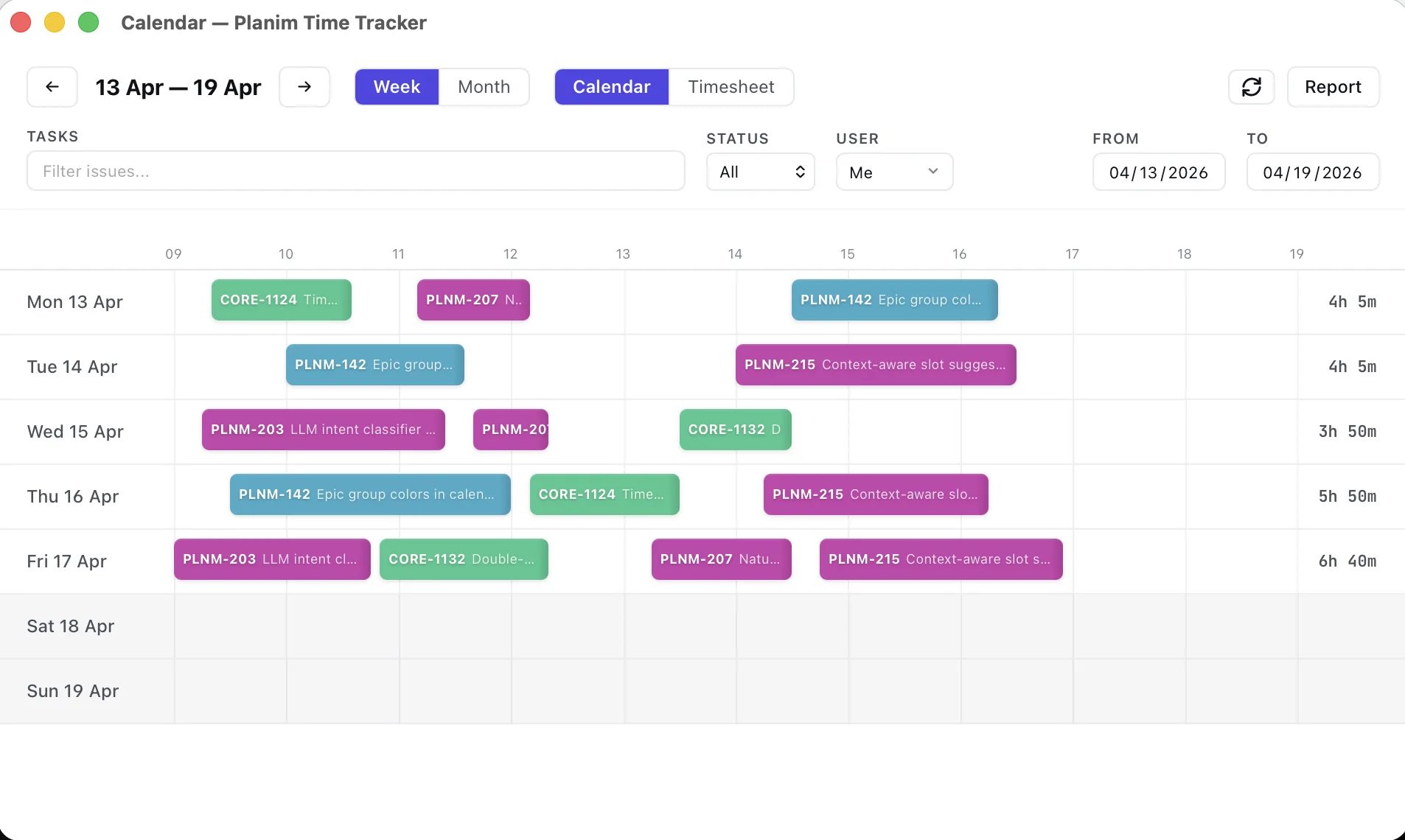
The fix isn’t a better guess. You can’t out-discipline a structural bias by concentrating harder during refinement. The fix is a calibration loop: log the real time, compare Time Spent against the Original Estimate across closed tickets, and fold the ratio back into your next round of estimates. Jira gives you both numbers and never once puts them side by side, which is why most teams never close the loop. We ended up building that side-by-side list into Planim Time, our desktop Jira tracker, and it comes up below at the step it shortens.
I spend my days on the actuals side of this. The patterns below are what I’ve watched separate teams whose estimates slowly get useful from teams that argue about estimates forever.
Estimates are biased, not noisy
The distinction that matters: a noisy estimate is sometimes high, sometimes low, and averages out over enough tickets. A biased estimate is wrong in the same direction every time, so it never averages out. Software estimates are biased low, and the reasons are structural, not personal failings. Psychology has a name for this pattern, the planning fallacy, first described by Kahneman and Tversky; the classic demonstration is Buehler, Griffin and Ross’s 1994 study, where students predicted their thesis work would take 33.9 days on average and it took 55.5.
- You estimate at peak ignorance. The number goes on the ticket during refinement, before anyone has opened the file, hit the edge case, or found the undocumented dependency. The estimate reflects the story as understood, which is always simpler than the story as built.
- You estimate the happy path. “Add a field to the form” is two hours if nothing else happens. The real ticket includes the review round, the red CI, the Slack question that takes a day to get answered, and the migration the field turns out to need. None of that is in the estimate, and all of it adds time.
- Scope grows after the number is frozen. Jira’s Original Estimate locks the moment you set it; the mechanics of that, and how it differs from Time Spent and Remaining, are in Original Estimate vs Time Spent. The scope is not frozen. By the time the ticket closes, “small change” has absorbed three follow-ups that never got their own estimate.
- The unit quietly lies. An “8h” estimate reads as one working day. A working day is not eight hours of focused ticket work. Subtract standup, two meetings, the review you owe someone else, and the context reload after lunch, and a calendar day holds maybe four or five hours of the work the estimate actually describes. Estimate in ideal hours, measure against calendar days, and you run “over” even when nothing went wrong.
Every one of these pushes the actual time up, never down. That is why the miss is reliable instead of random.
Jira makes the miss invisible
Here is the part that keeps the bias alive: Jira holds both numbers and never shows you the gap.
Original Estimate holds your prediction. Time Spent holds the rolling total of every worklog. They sit on the same issue. But no built-in report says “this ticket ran 60% over” or “your five-pointers average 1.6x their estimate.” The Time Tracking report shows estimate and spent in adjacent columns and leaves the subtraction to you. The Sprint Burndown, when it’s reading Remaining Estimate, actively hides the over-run, because Remaining drops as you log work and you can re-pad it the moment reality bites. (The four Remaining behaviours, and which one your tracker uses, are in that same field post above.)
Story points were supposed to sidestep all of this by being relative instead of absolute. They help with planning, but velocity drifts for the same underlying reason: the work behind a point is bigger than it felt during refinement. I went through where points and hours each belong in story points vs hours. Either way, the system records your prediction and your actuals and never confronts you with the distance between them. A bias you can’t see is a bias you can’t fix.
What actually works: calibrate, don’t guess harder
You will not estimate your way out of a structural bias by trying harder. What works is treating your own past estimates as a measuring instrument with a known error, and correcting for the error.
The loop is simple to state:
- Log real time, honestly. Calibration runs on actuals, so the actuals have to be real. The fastest way to poison it is back-filling worklogs on Friday to match what you estimated, which makes the data agree with the guess by construction and teaches you nothing. (This is the same trap that kills hours-for-calibration in the points-vs-hours post.) A timer that captures the work as it happens beats reconstructing the week from memory.
- Compare Spent to Original on closed tickets. Once a sprint or once a quarter, pull the closed issues and look at Time Spent against Original Estimate, grouped by issue type or by person. Individual tickets are noisy and you should ignore them one by one. You’re looking for the ratio across many.
- Apply the ratio forward. If your “one day” tickets reliably take a day and a half, your multiplier is 1.5. Use it. An estimate corrected by a measured bias beats a fresh guess, because the guess will repeat the same optimism the multiplier already accounts for.
Step 2 is the one I never did by hand twice. In Planim Time, switching on Include estimates in Team Statistics adds an Estimate vs Actual list: issues that have an Original Estimate and worklogs in the period you picked, each with the estimate, the hours logged and the percentage over or under, twenty at most, worst overrun first (Pro). It is a per-ticket list, so the ratio across many is still yours to work out. One more caveat: the logged side counts the selected people’s worklogs inside that period, not the issue’s lifetime Time Spent, so set the range wide enough to cover the tickets from first worklog to close.
The thing I’d tell anyone starting this: the multiplier is stubborn and personal. My own estimates run short by a margin that has barely moved in years of measuring it, across very different kinds of work. I stopped treating that as a flaw to fix and started treating it as a constant to apply. Knowing my number is worth more than any amount of resolving to “estimate more carefully next time,” because the number is real and the resolve never survives contact with the next ticket.
Two smaller habits keep the loop honest:
- Estimate ranges, not points. “Half a day to two days” is truthful about uncertainty in a way “1d” pretends away. The wide end is where the bias lives.
- Re-estimate Remaining for real, mid-flight. When a ticket turns out bigger, set Remaining to a new honest value instead of letting the default auto-decrement lie about how much is left. That keeps the in-sprint picture truthful before the calibration loop ever runs. Where I usually notice a ticket has outgrown its number is Planim Time’s issue list: once an estimated issue has time on it, it gets a pill with logged over estimate as a percentage, green up to 100%, yellow up to 120%, red past that (Free).
What doesn’t work
- A flat fudge factor from the air. Doubling every estimate “to be safe” isn’t calibration, it’s a different guess. It over-pads the simple tickets, where Parkinson’s law then expands the work to fill the room you gave it, and still under-pads the ones that detonate.
- More granular estimates. Breaking an 8h ticket into eight 1h subtasks gives you eight chances to be optimistic instead of one. Precision is not accuracy; the bias rides into every subtask.
- Switching to story points to dodge the problem. Points move the estimate off the clock, which genuinely helps planning, but the optimism doesn’t stay behind. Velocity drifts until you calibrate it the same way, against real cycle time.
- Demanding tighter estimates from the team. Pressure for smaller numbers gets you smaller numbers, not truer ones. People estimate what’s safe to say out loud, and “five days” is rarely safe to say in a planning meeting. Leaning on the team makes the bias worse.
The short version
Jira estimates are wrong in a predictable direction because they’re made early, cover the happy path, and ignore that a calendar day isn’t a working day. Jira stores both the prediction and the actuals and never shows you the gap, so nothing corrects the bias on its own. The repair isn’t a sharper guess. It’s logging real time, measuring how far your estimates land from reality, and applying that ratio to the next ones. The first accurate thing most teams can say about their estimates is how wrong they reliably are, and that number, once you have it, is the most useful estimate you own.